Intro and Apology:
Welcome to the third installment of Going Analog, a blog post series about digital minimalism in the 21st century. This time, we’ll investigate how to build a social life with minimal use of digital technology.
First, though, I owe you an apology. The delay between this and my last installment was enormous. My mission was bogged down during the last semester by many unexpected obstacles. Given how professors complain about student phone use, they sure do make it hard to not use your phone.
It is no longer possible to attend college without a phone and a computer. Long gone are the days when students turned in their homework to the teacher’s basket at the beginning of class. Classes now universally use Canvas (an education management tool) to provide documentation and data, share lecture recordings, contact staff, manage project groups, assign homework, and accept homework submissions. This wouldn’t be such a huge problem for me, since I allow myself some degree of computer use (as a computer science major, I can do little else). But avoiding cell phones became impossible when my archnemesis appeared: IClicker.
IClicker is a phone and web app college teachers use to record participation and give interactive questions to students during lectures. It’s an excellent idea that didn’t need to be an app: the teachers could just as easily have people raise their hands to answer the questions. Unfortunately, iClicker meant that I had to bring my phone to class just get participation credit. A specialized non-phone remote for iClicker exists but I never got it to consistently work. Once I was bringing my phone to class every day, I was too tempted to use it, and continuing the experiment became impossible.
This symbolizes a broader change in Western society: shortly after cell phones became widespread, new infrastructure began to assume people had them. Just as our material wealth increased, the expectations for our wealth increased as well. Today our surroundings are so full of QR codes, two-factor auth gates, and app-only functionalities that choosing to go without a cell phone puts you at a serious disadvantage.
Of course, much can only be done with phone-based infrastructure. Assuming people will have a phone comes with advantages. All the same, its an assumption that increases the power of the techlords and makes it harder to escape phones for those who want to.
The Problems of Digital Social Life
In this blog post, we’ll cover what an analog social life looks like. This will be our longest part yet because screens impact this dimension of our lives more than any other. The digital revolution has been above all a social revolution.
Our screens wire us into a new type of social graph, vaster and denser than any before it. The digital graph affords us many great new opportunities to connect with others, and this is probably a boon to humanity overall. However, it is not without its costs.
Humans are designed for close, highly-connected in-person social graphs strengthened by daily interaction with the same group of peers. We’re not built for the vastness of cyberspace. We stare into the digital abyss too long and see colors out of space. We lose our minds. We become sadder, more anxious, and more envious. Gen Z has never known anything else and is more neurotic and less conscientious than previous generations.
There are many great reasons to want to reclaim the way of socialization of just the last generation. We can reclaim the social world until yesterday.
A Short History of Predigital Social Life
How did this world work? I need to actually ask this question, because I never lived it, though the majority of living Americans have. In this essay, I’ll focus on America for a couple of reasons:
-
It’s the culture I’m most familiar and it’s where my family comes from, so I have access to firsthand accounts of this predigital American social life that would be harder for get to other cultures.
-
From the 1950s onward, American social ways of being and pop culture were and continue to be incredibly influential. American social traditions as portrayed in movies like American Graffiti and Forrest Gump were incredibly influential from Latin America and Europe to the most distant lands of Asia. Therefore, learning about American socializing in the late 20th century tells us a lot about socializing in other countries.
For a firsthand perspective of predigital life, I asked my Dad, who grew up in the 70s and 80s. He recounted the following vignette of his youth [paraphrased, emphasis mine]:
“When I was a child, ‘dropping by’ friends’ house with the bicycle after school was common. You didn’t need to text or message them beforehand, you just went up to the house and rang the doorbell. If their parents answered, you would ask if they could play or not. If they couldn’t, that was that. If they could, you’d play until sundown.
We also did arcades a lot as a teenager, and I would ride my bike to the arcade. When I was 14 or 15, I’d go to the game room and play a few video games and the ice hockey table. I loved Defender, Missile Command, and Centipede. I thought the pinball machines were more boring than the video games. Pinball was more of a 70s thing, and in the 1980s video games basically replaced it.
We’re more entertained these days than we used to be. We used to be kind of bored all the time. Unless you were watching TV or reading a book, the general nature of life was really rather boring. People watched a lot of TV and Movies back then. Now we’re a highly entertained society.
Back then, if you wanted to learn something new, you had to go to the library and the card catalog and deal with the librarian to get what you needed out of the library.
I got a car at 16, and started working as a bus boy at a restaurant (Spoons) at 16. These measly jobs were a form of socializing. As a young adult, you went to parties and bars every weekend. The drinking age in Texas was 18 until 1986. We also cruised around in our cars a lot— nowadays the law has hunkered down on that. Drinking and driving wasn’t even considered much of a concern in the 1980s. The first became a thing with “Mothers against Drunk Driving.” The insurance and the police companies loved it. Nowadays, you’re not even allowed to have a friend in the car if you’re 16.
We also did motorcycle touring with Marvin [an old family friend]. I always like motorcycles. Later I became really into cars, especially as a young adult.”
A common theme in accounts of predigital social life is how much more restricted children are than they used to be. Like my dad said, teenagers aren’t even allowed to have their friends in the car anymore. In the 70s, America was a less regulated society. When my mom grew up in Boulder in that decade, she saw people driving across the canopy of a covered bridge on motorbikes multiple times. There’s no way that would happen today.
Similarly, when my uncle was growing up in Baltimore in the early 70s, he and his friends took empty refrigerators from the junkyard. Refrigerators, being concave and being able to hold lots of air, turn out to make great boats. They took the refrigerators and rode on them through the Patapsco River, passing the neighborhoods of Baltimore along the way. I doubt you could get away with this today, when everyone has a camera in their pocket.
From these accounts a few themes typically emerge:
-
Most forms of entertainment required leaving the house. Want to play video games? You need to go to an arcade. Movies? Go to the theater. Books? Go to the library. Now we can get the best of all three at home. Is it more convenient? Sure. Does this eliminate the incentive to go outside and make friends? Absolutely.
-
There was a relative lack of regulation. Young teenagers used to cruise around all the time, and even get into trouble, without serious consequences. Nowadays they would be arrested for the same behavior. While this has no doubt increased public safety, it has also resulted in more young people alone and in their homes.
-
People were bored a lot. Relatives have always taught me that they were bored when they were kids. This may be the most important and fundamental difference in the nature of human life in the predigital and postdigital world. Today you can choose to never be bored, except maybe at work. You can be stimulated constantly. While being bored all the time probably isn’t good, the optimal amount of boredom isn’t zero. Abolishing boredom removes an important cornerstone of the human condition. It makes you less prepared to work and hampers creativity. How many kids today would even think of riding fridges down a river?
Generally speaking, the main difference between our social lives now and the predigital social life is that, before digital media took over our lives, localism was fundamental.
People’s social lives came from their families and local communities. This led to less inequality of the degree of each node on the social graph. (Which is to say, less inequality in the number of friends people had.) Mass media led to celebrities, but there were no “influencers” or parasocial relationships. You couldn’t talk back to a famous person. For most people, the local community better served their fundamental needs then our modern online communities, since meeting someone in person engenders good feelings and activates more of our brains than online interaction.
How is predigital community organized? It is a network of networks, formal and otherwise, that we can visualize as a series of concentric circles increasing in spatial scope:
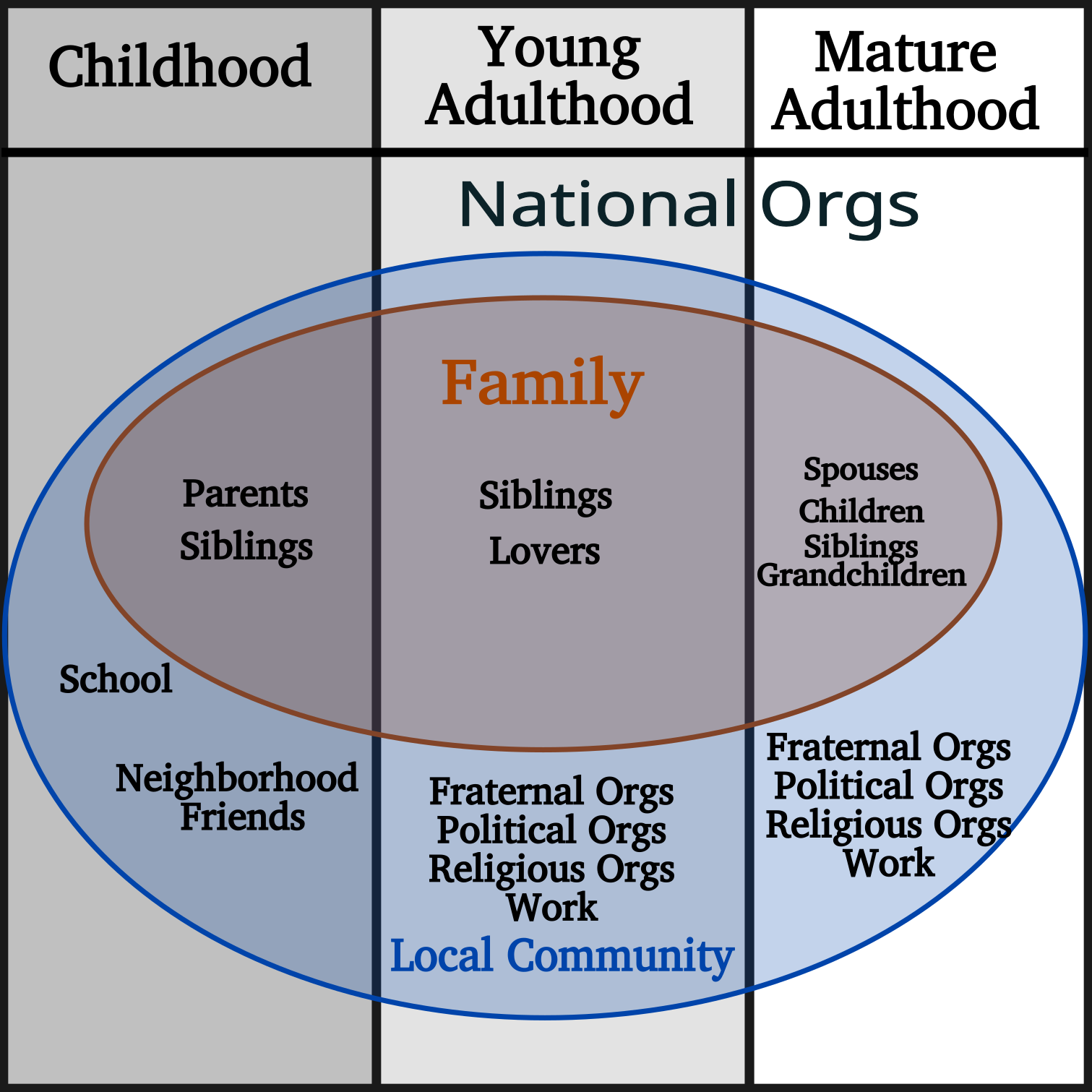
At the core of the system is the family. Farther from a person, but still quite close, is their local community. Farther still is the national and even global community, represented by various civic organization, political parties, international organizations, and more. However, in practice those outside the blue circle mattered little: it was the blue circle and further within it that mattered the most. The concentrated center is a sign of localism: an emphasis on local over distal communities.
In Praise of Localism
I call localism a virtue. The average person has little or no power to leverage national or international affairs, but more power than they realize to help their friends and neighbors. We shouldn’t close our eyes to international events, but most people now are more in danger of the opposite error. Nowadays, people get play-by-play reports of far-flung wars while at the same time ignoring their friends and family. Ruminating over disasters that you can’t help and that don’t affect you is a waste of time. I want “checking the news” to mean asking my friends what’s new. I want “browsing” to mean browsing the local storefronts. My activism will be for my friends and neighbors— not for causes I barely understand on the other side of the world. 1
The analog-minded person thinks local, not global. They operate fully within their circle of influence and don’t rage impotently at events outside their control. They refuse to worry about things outside their circle of influence, and as a result they are much happier.
Going (Socially) Analog
So, what are the concrete steps to dedigitalizing social life? Do the following:
-
Be friendly to strangers. When traveling, it is fascinating to note that each place has a “stranger temperature” that mediates whether strangers default to greeting each other warmly or coldly. Some places, like New York or Northern Europe, have a cold stranger temperature. Other places, like rural America, Mexico, and Southern Europe, have a warm temperature. It’s a good thing to warm up the temperature in your local community by being kind and friendly to strangers. Make it a point to make them smile by complimenting them on something. Make their day just slightly brighter.
-
Join local social groups — religious organizations, exercise groups, hiking groups, or any sort of club are all good bets. If the type of club you want to go to doesn’t exist, make it. The fraternal and sororal organizations that used to be the bedrock of American civic society still exist: the Bluebirds, the Freemasons, Toastmasters, the Knights of Columbus, and many, many more. Join them.
-
Delete your social media, of course.
-
Live with friends if possible. Living with friends is very common and very good. This used to be the norm during the age of American boarding houses. See the next section for more on this.
-
Call, don’t text? This one I’m less sure about. But calling people generally leads to longer, higher-quality conversation than just texting. Then again, texting can also be a good source of sociability and the friend group chat is a venerable social institution of our time.
On Group Living
I’ve had a few major experiences with group living. For now, I’ll focus group houses.
I consider weird group houses to be an important model for in-person community in the twenty-first century. As marriage rates collapse and home prices rise, they may even replace the nuclear family as the default small-scale living arrangement. My friend–we’ll call him Roy—runs a group house in Berkeley called Timecube.
Timecube is a good social scene primarily by circumstance and only secondarily by intention. Roy keeps good relationships with interesting people in the Bay Area. Since real estate there is rare and expensive, these people often end up needing a cheap place to live. Timecube fills that niche. Meals are often shared. Events are largely happenstance— one or more people randomly decide to watch a movie, and later more tenants join in just out of curiosity. The spontaneity of life at Timecube is one of its greatest charms. You don’t have to schedule things, things just happen.
I asked Roy about the differences between online and in-person socializing. He said— and I agree — that online is better for discovering niches. But “hanging out” is much better in person. My modus operandi is to “find” people in niche spaces online, then meet them in person to create real-life niche communities.
My impression from older relatives is that people socialized in-person more often in the late 20th century in part because they had no alternative. Movie theaters were centers of social life and people saw their friends in-person almost every day. (It shows you just how much things have changed that I have to specify in-person, when this would be considered a bizarre specification for almost all of world history).
My mother and aunt held dozens of basement parties, and there are rows upon rows of bottles in the basement shelves to prove it. Nowadays Gen Z is partying less than any other generation and it shows in our increased loneliness and fewer friendships.
So, inviting people over, and even keeping an open invitation, is vital.
Conclusion
Replacing our in-person communities with screen time has been a disaster for the human race. Because of contemporary phonecentric infastructure, it’s very difficult to completely avoid phone use. But most of us can use our phones less and reclaim the benefits of in-person socializing. Deleting social media, joining groups, and living communally are all good ways to do this. As we move toward analog socializing, we’ll find deeper and more enduring social connection that better fills our needs.
- Yes, I know Effective Altruists argue you should focus on events happening far away from you (though not the ones most people focus on) for reasons of marginal utility. I’d like to address this argument— but that’s a topic for a much later essay.↩
